Delentia OS
A self-hosted AI agent runtime in which the model only proposes. Every tool call is judged before it runs, anything that writes, sends or runs code waits for a person's signature, and every episode leaves a record you can verify.




Experimental research software
Delentia OS is a research project by one creator. It is not production-stable, no strong hosted model has driven it yet, and nothing here runs anywhere except on your own machine. What is measured, and what is not.
What it is
AI agents can plan and use tools. What happens when the model misreads you, reads a hostile web page, or the process dies halfway through a job? Most setups rely on the model behaving. Delentia OS does not: the runtime sits between the model and the tools and decides.
- Governed tool use. A gate (a score, your own policy, and a rule about untrusted text) judges each call. Reading is quiet; writing, sending and running code stop and wait for a signature from a key or a device you own.
- A rule for hostile content. Text that comes from outside marks the episode as tainted; from then on anything that could send or change something needs a signature, whatever the model says.
- Verifiable records. Each episode is written to a hash-chained, signed audit log you can re-check offline.
- Your model, your machine. A local model (Ollama), any OpenAI-compatible endpoint, or OpenRouter.
The governed cycle
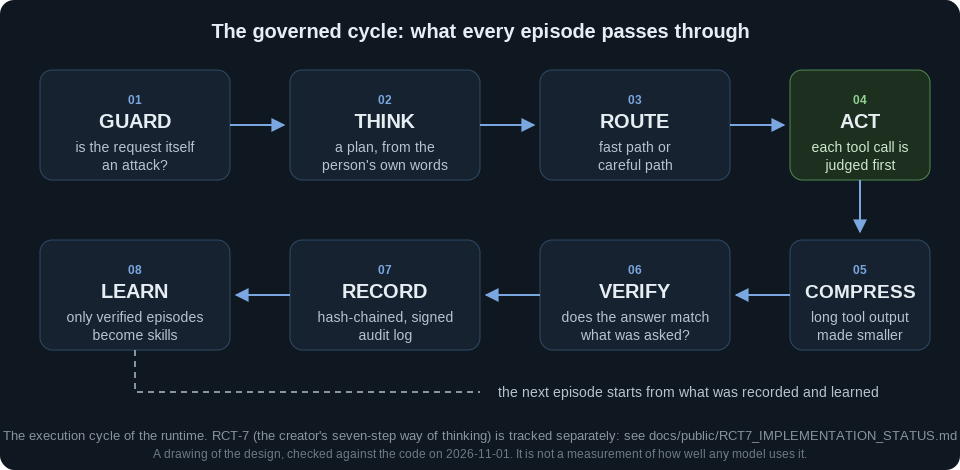
Every episode passes the same fixed cycle: GUARD (is the request itself an attack?) → THINK (a plan) → ROUTE (fast or careful) → ACT (each tool call is judged first) → COMPRESS (long tool output made smaller and recoverable) → VERIFY (does the answer match what was asked?) → RECORD (a signed, hash-chained audit log) → LEARN (only verified episodes become skills). RCT-7, the creator's seven-step way of thinking, is a separate thing, tracked in its own status page.
Where the model stops and the runtime decides
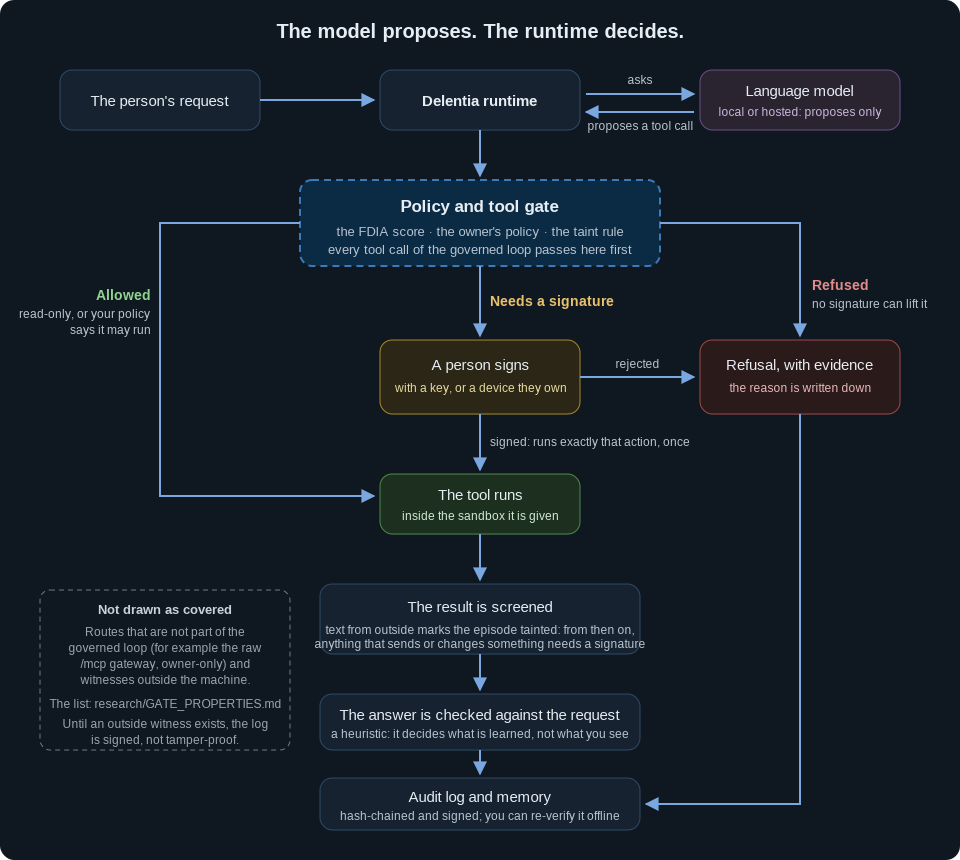
The drawing shows the governed loop. It does not claim that every route into the system passes the gate: the routes outside the loop are listed in the gate properties, and until a witness outside the machine exists the log is hash-chained and signed, not tamper-proof.
The FDIA Equation
| Symbol | The creator's meaning | What the runtime computes |
|---|---|---|
| F | Future: the outcome that actually happens | An action-admissibility score, not the future and not a calibrated probability |
| D | Data: reality and experience, good and bad | A data-evidence score in [0, 1] built from the person's own files, memory and the clarity of the request |
| I | Intent: the exponent that gives the data direction | A strictness value, about 0.5 to 2, from the kind and risk of the goal |
| A | Architect: the human who designs, decides and answers for the outcome | The owner's policy plus a verifiable signature for protected actions |
Because D is in [0, 1], a larger I makes F smaller for the same D: a clearer, more demanding intent needs better data to pass. No accuracy figure is claimed for the score; see the benchmark methodology for what has and has not been measured. The equation has no official expanded name. The full explanation.
What is measured, and what is not
| Evidence | Where it stands |
|---|---|
| The public test suite | See Testing for the current checkpoint, the run and the caveats. It is evidence about the code, not about how well a model uses it |
| The gate against a scripted attacker | A model that obeys every injected instruction: the taint rule stops every harmful side effect in the scenarios tried; method and limits in the threat model |
| A strong hosted model driving the runtime | No result yet |
| Independent reproduction | None yet |
| Production readiness | Not declared |
Hallucination rate: not claimed (an earlier 0.3% figure was withdrawn on 2026-09-28 because it could not be reproduced). Memory deltas are 39% (20 ticks) to 90% (500 ticks) smaller than a full snapshot per tick, measured in bytes; plain compression of snapshots does as well, so this is a property of the format, not a claim of being better.
Start
- Install: Installation (Windows installer,
pip install delentia-os, from source) - First run, no model and no key: Quick start
- What the system is, in one page: Current public information · Whitepaper 3.0
- Detail that used to be in the README: Reference
- Limits and risks: Known limitations · Threat model · Comparison with other runtimes